The Enemy Hangs Out in the Hallway
Why opposition shows up at the open door, and how you break through into your new season

When Paul wrote his first letter to the church in Corinth, he was living in Ephesus. Near the end of the letter, he told them why he wasn’t coming to see them yet.
“But I will stay at Ephesus until Pentecost, for a great and effective door has opened to me, and there are many adversaries.”
1 Corinthians 16:8-9
Read that again slowly. A great door, and many adversaries. Paul put them in the same sentence because they showed up in the same season. He didn’t treat the opposition as a sign that the door was false. He treated it as one more reason to stay.
I’ve learned this the hard way over decades of ministry in more than 40 nations. Open doors draw opposition. When God opens something new for you, the enemy rarely sits back and watches. He shows up at the entrance. And very often, he hangs out in the hallway.
The Door and the Devil
The door in Ephesus was real. Luke tells us that Paul taught every day in the lecture hall of Tyrannus for two years, “so that all those who lived in Asia heard the word of the Lord Jesus, both Jews and Greeks” (Acts 19:10). God did unusual miracles through Paul’s hands. Handkerchiefs that had touched him were carried to the sick, and they were healed. People who had practiced magic brought their books and burned them in front of everyone. When they added up the value, it came to fifty thousand pieces of silver (Acts 19:19).
That’s what an open door looks like. Lives were changed, a city was shaken and a whole region heard the gospel.
Then the pushback came. A silversmith named Demetrius made silver shrines for the goddess Artemis, and Paul’s preaching was hurting his business. He called the other craftsmen together and stirred them up. Soon the whole city was in an uproar, and a crowd rushed into the theater shouting, “Great is Artemis of the Ephesians!” for about two hours (Acts 19:23-34).
The miracles and the mob came out of the same city. The breakthrough and the backlash came in the same season.
Maybe you know exactly what that feels like. God has opened something for you. It might be a new role, a new ministry, a move to a new city, a business, or a calling you finally said yes to after years of waiting. You can see the door. You know God opened it. And just as you step toward it, the pressure starts. Money gets tight. A relationship turns sour. Your body gets tired. Your mind fills with questions you thought you had settled.
If that’s you, I want you to hear this clearly. Pressure at the door doesn’t mean you missed God. Sometimes it means you found Him.
Hell in the Hallway
In my book Unsettled, I write about a place many believers know but few talk about. It’s the space between the door that has closed behind you and the door that hasn’t opened yet in front of you. You’re no longer where you were, and you’re not yet where you’re going. You have nothing to go back to, and the way forward looks blocked. Some people have called it hell in the hallway.
Scripture is full of hallways. Israel had the hallway of the wilderness between the slavery of Egypt and the promise of Canaan. Joseph had the hallway of the prison between the pit and the palace. David had the hallway of the cave between the day Samuel anointed him and the day he took the throne. Even Jesus had hidden years in Nazareth and forty days in the wilderness before His public ministry began.
I’ve come to believe that God does some of His finest work in hallways. When every door is open and life is going well, we tend to coast. We lean on our gifts, our momentum and our reputation. But in the narrow passage between rooms, there’s nothing to lean on. The hallway strips away our props, and once they’re gone, we’re finally ready to be changed.
So the hallway isn’t wasted. But it isn’t safe either. And that brings us to Amalek.
Join my destiny mentoring class for free. It’s happening Tuesday, November 17 at 6 PM Central time in the USA and Wednesday, November 18 at 10 AM Australian Eastern Standard Time
Sign up here https://us02web.zoom.us/meeting/register/al_ccyFuQJGyezLvdVLqcQ
The Enemy Hangs Out in the Hallway
Israel had just walked out of Egypt. They had watched God split the Red Sea, and they had walked through on dry ground. They had eaten manna from heaven and drunk water from a rock. They were free, but they weren’t formed yet. They were a nation of former slaves who had never fought a battle.
Then, at a place called Rephidim, “Amalek came and fought with Israel” (Exodus 17:8).
Forty years later, Moses stood before the next generation and told them to remember how it happened.
“Remember what Amalek did to you by the way as you came out of Egypt; how he met you by the way, and struck the rearmost of you, all who were feeble behind you, when you were faint and weary; and he didn’t fear God.”
Deuteronomy 25:17-18
Look at where the blow landed. Amalek didn’t charge the strong center of the camp. He didn’t face Israel’s best men head on. He crept around to the back of the line and went after the stragglers. He struck the people who were slow, sore, sick and struggling to keep up. He picked off the ones who were faint and weary.
Amalek didn’t attack the strong. He stalked the stragglers.
The ancient Jewish historian Josephus, writing about this same battle, records the reasoning of Amalek’s leaders. They argued that it was wiser to crush a people while they were still weak and wandering than to wait until they became strong. Whether or not those were their exact words, the strategy is clear. Attack early. Attack the weary. Attack before the promise has time to grow up.
That’s still how the enemy works today. He doesn’t know your future the way God does. He doesn’t need to. He only needs to find you tired, isolated and unsure in the hallway between what was and what will be.
What Amalek Looks For
In Unsettled, I put it this way: weariness lowers our resistance, uncertainty clouds our judgment and isolation leaves us exposed. Let me walk you through each one, because you need to see how Amalek works if you’re going to beat him.
Weariness wears down your defenses. Transitions are tiring. You’re grieving what ended while you build what’s next. You’re making decisions you’ve never had to make before. When you’re exhausted, small things feel huge. A critical comment cuts deeper. A delay feels like a denial. Temptations you would have laughed at a year ago start to look reasonable. Amalek waits for the weary.
Uncertainty unsettles your judgment. In the hallway, you can’t see the next room yet. You start second-guessing what God told you. Did I really hear Him? Should I go back? Maybe I made all of this up. The enemy loves to work in the fog. He whispers that God has forgotten you, that the door was never real, and that you’d be better off where you were.
Isolation leaves you exposed. The people at the back of Israel’s line had fallen behind the group. They were alone, and that made them easy targets. The same is true for you. When you’re wounded, embarrassed or confused, your first instinct may be to pull away. You stop answering calls. You skip church. You tell yourself you just need some space. Sometimes rest is right, but isolation is something different. Space can turn into a prison if you stay there too long.
Transition is the target. When you’re settled, you have your routines, your footing and your people. In transition, the old supports are gone and the new ones aren’t built yet. You’ve let go of one handhold and haven’t grabbed the next one. That’s the moment Amalek likes best.
Small Towns and Big Trouble
There’s another danger in the hallway, and it doesn’t come from weakness. It comes from success.
After forty years in the wilderness, Israel finally crossed the Jordan. Their first battle in the Promised Land was Jericho. They marched around the walls, the priests blew the trumpets, the people shouted and the walls fell flat. Nobody could have won that battle without God.
Then they came to a little town called Ai. The scouts came back with a confident report.
“Don’t let all the people go up, but let about two or three thousand men go up and strike Ai. Don’t make all the people to toil there, for there are only a few of them.”
Joshua 7:3
It sounded like common sense. So a small force went up, and the men of Ai chased them away and struck down thirty-six of them. “The hearts of the people melted, and became like water” (Joshua 7:5).
What went wrong? The first verse of the chapter tells us. Achan had taken things God had set apart and hidden them in his tent, and “Yahweh’s anger burned against the children of Israel” (Joshua 7:1). On top of that, Israel went up against Ai without asking the Lord. They leaned on yesterday’s victory. They assumed the win.
Big victories can breed small prayers. After Jericho, Ai looked too small to need God. But the smallest town in Canaan was more than they could handle without Him.
Watch for this in your own hallway. You may survive a huge crisis and then stumble over a small obstacle because you face it without God. The danger is usually the thing you’re carrying inside, not the size of what’s ahead. It might be compromise you haven’t dealt with, disobedience you’ve hidden or prayerlessness you excuse because you feel strong.
The good news is that Ai wasn’t the end of the story. When Israel dealt with the sin, God spoke again. “Don’t be afraid, and don’t be dismayed... I have given into your hand the king of Ai” (Joshua 8:1). The place of defeat became a place of victory. God may allow a painful setback to show you what success was hiding, and to call you back to depending on Him.
The Pull of the Past
Sometimes the enemy doesn’t attack you at all. He just invites you back.
After Jesus died and rose again, the disciples were in their own hallway. Everything had changed, and they didn’t know what came next. So Peter said, “I’m going fishing,” and the others went with him. “That night, they caught nothing” (John 21:3).
I don’t think Peter was walking away from his calling. He was a fisherman, and there may have been practical reasons. But the scene shows something deeply human. When the future is unclear, the familiar feels safe. The old boat, the old nets and the old life start calling your name.
Look at what Jesus did. He met them at dawn on the shore. He filled their nets, cooked them breakfast and then gave Peter a fresh commission: feed My sheep. Jesus used an ordinary night on familiar water to restore Peter’s calling and point him forward.
If the old life has stopped working for you and the nets keep coming up empty, don’t rush to call it judgment. But pay attention. God may be using your dissatisfaction with the familiar to turn your eyes toward what He’s asking of you now.
Pressure Is Not Proof
Before we talk about how to break through, I need to be honest with you. Not every hard thing at a doorway comes from the devil.
In Acts 16, Paul tried to preach in Asia, and the Holy Spirit stopped him. He tried to go into Bithynia, and “the Spirit didn’t allow them” (Acts 16:7). That closed door led him to Macedonia, and the gospel went into Europe for the first time. Later, in Ephesus, Paul faced fierce opposition at an open door, and he stayed.
Both stories are in your Bible. If you treat every obstacle as a closed door, you’ll quit too early. If you treat every obstacle as an attack to push through, you’ll keep banging on doors God has shut.
I’ve had to learn this myself. There was a season when the ground shifted under me. Relationships that had been solid grew uncertain. Doors that used to open easily began to close. I asked the Lord whether I had missed Him, whether I had failed, or whether the enemy was fighting a work of God. It took me far too long to accept the answer. It was none of those things. God was closing a chapter He had never meant to be the whole book. When I finally opened my hands and let go, the new direction began to come into view.
So ask God first. Has He spoken clearly to you about this door? Do His Word, His peace and the counsel of mature believers all point the same way? If they do, then pressure at the door is not a reason to turn back. Pressure is not proof that you missed God. Sometimes it’s proof that the door matters.
How You Break Through
Now let’s go back to Rephidim, because Exodus 17 doesn’t just show you how Amalek attacks. It shows you how Israel won.
“Moses said to Joshua, ‘Choose men for us, and go out, fight with Amalek. Tomorrow I will stand on the top of the hill with God’s rod in my hand.’”
Exodus 17:9
Joshua went down into the valley. Moses, Aaron and Hur went up the hill. Here’s what happened next, and here’s how you can break through in your own season.
Hands High on the Hill
“When Moses held up his hand, Israel prevailed. When he let down his hand, Amalek prevailed.”
Exodus 17:11
The battle in the valley was decided on the hill. Prayer wasn’t an extra. It was the strategy.
Notice that Joshua didn’t sit in the tent waiting for Moses to finish praying. And Moses didn’t grab a sword and run down to fight. Prayer and action went together. Pray over your door every morning. Then do the next practical thing God has shown you. Send the email. Make the call. Fill out the application. Show up.
And keep praying until something moves. After Jesus ascended, the disciples waited in Jerusalem between the promise and the outpouring. Luke says they “continued steadfastly in prayer and supplication” (Acts 1:14). The hallway isn’t the place to abandon the secret place. It’s the place to go deeper in it.
Worship Before the Win
In Acts 16, Paul and Silas were beaten and thrown into prison in Philippi, the very city God had redirected them to. Their feet were locked in stocks. Their backs were bleeding. And “about midnight Paul and Silas were praying and singing hymns to God, and the prisoners were listening to them” (Acts 16:25).
They didn’t wait for the chains to fall off before they sang. Their praise came before the breakthrough. Then “suddenly there was a great earthquake... and immediately all the doors were opened” (Acts 16:26).
Worship takes your eyes off the door and fixes them on the One who holds the keys. Worship in the hallway says that God is still good when nothing makes sense, and still faithful when the timeline doesn’t add up. Bless Him before the answer. Sing before the prison shakes. Tell your soul what’s true before your feelings agree.
Friends Who Hold Up Your Hands
“But Moses’ hands were heavy; so they took a stone, and put it under him, and he sat on it. Aaron and Hur held up his hands, the one on the one side, and the other on the other side. His hands were steady until sunset.”
Exodus 17:12
Moses was the leader of the whole nation, and he still got tired. He couldn’t hold his arms up alone. So Aaron and Hur gave him a rock to sit on and held up his hands until the sun went down.
You weren’t made to fight Amalek alone. The enemy thrives in secrecy, but healing grows in the light. Stay planted in your church. Let people know where you really are. Pick two people you trust and tell them the truth about how you’re doing. Ask them to pray with you until this breaks. And when they offer you a rock to sit on, take it.
Step Out of the Stragglers’ Line
Amalek struck the ones who fell behind. So don’t drift to the back.
If you’ve stopped going to church, stopped reading your Bible, stopped praying with others or stopped answering the people who love you, take one step back toward the center this week. Go to the prayer meeting. Join the small group. Sit with a friend over coffee and tell them what’s going on. You’ll be amazed how much safer you feel when you’re walking with the people of God again.
Wait, Don’t Wander
“But those who wait for Yahweh will renew their strength. They will mount up with wings like eagles. They will run, and not be weary. They will walk, and not faint.”
Isaiah 40:31
The Hebrew word for wait here is qavah. It carries the idea of both waiting and hoping. It’s often linked with the picture of strands being twisted together into a cord. Biblical waiting isn’t sitting around doing nothing. It’s leaning forward in hope because you know the One who spoke is faithful. As you wait on Him, your weakness gets wrapped around His strength.
Amalek attacked the faint and weary. Isaiah promises that those who wait on the Lord will run and not be weary, and walk and not faint. God’s answer to Amalek’s strategy is renewed strength for people who stay close to Him.
So wait, but don’t wander. Stay faithful in the small things already in your hands. Don’t despise the present because you’re waiting for the future. Paul put it simply: “Let’s not be weary in doing good, for we will reap in due season, if we don’t give up” (Galatians 6:9).
A Banner Over the Battle
“Moses built an altar, and called its name ‘Yahweh our Banner.’”
Exodus 17:15
When the battle was over, Moses didn’t build a monument to Joshua’s skill or his own endurance. He built an altar and named it after God. In the ancient world, a banner was raised over an army so the soldiers could rally to it. Moses was saying that the Lord Himself was the one they rallied around, and the victory belonged to Him.
Your breakthrough won’t come because you’re stronger than Amalek. It’ll come because God is. Lift Him up over your battle. Rally to His name, not your own strength.
Write It Down for Joshua
After the battle, God gave Moses an interesting instruction.
“Write this for a memorial in a book, and rehearse it in the ears of Joshua.”
Exodus 17:14
God wanted the story written down and told to Joshua. Forty years later, Joshua would lead Israel across the Jordan into the Promised Land. He would face Jericho, Ai and battle after battle. God made sure he carried the memory of Rephidim with him.
Here’s a practical step. Take out a notebook this week and write down what God has already done to bring you this far. Write down the doors He opened, the battles He won and the prayers He answered. When the pressure comes, read it out loud. Then tell the story to someone coming behind you. Your hallway may become someone else’s hope.
The Door Is Still Open
Paul stayed in Ephesus through the riot. He stayed through the opposition, the accusations and the danger. In the same letter where he wrote about the great door and the many adversaries, he passed on a greeting: “The assemblies of Asia greet you” (1 Corinthians 16:19). Churches were springing up across the whole region, many of them in towns Paul had never visited.
That’s what was on the other side of the adversaries. The door God opened was worth the fight.
So if you’re standing in the hallway today, tired and unsure, with Amalek hanging around the back of the line, don’t sit down and don’t turn back. Get close to God and close to His people. Lift your hands. Let others hold them up. Worship before the win. And keep walking toward the door God opened.
A Prayer for You
Lord, You have opened a door in front of me, and I feel the pressure at the entrance. Show me clearly whether this is Your door. If it is, give me courage to stay and strength to keep walking. Where I’ve drifted to the back of the line, bring me back to Your people. Where I’m weary, renew my strength as I wait on You. Send people to hold up my hands when I’m tired. Search my heart for anything I’m carrying that doesn’t belong to me, and help me let it go. Teach me to worship before the breakthrough. You are my banner, and the victory belongs to You. In Jesus’ name, amen.
Walk Through This Season With Me
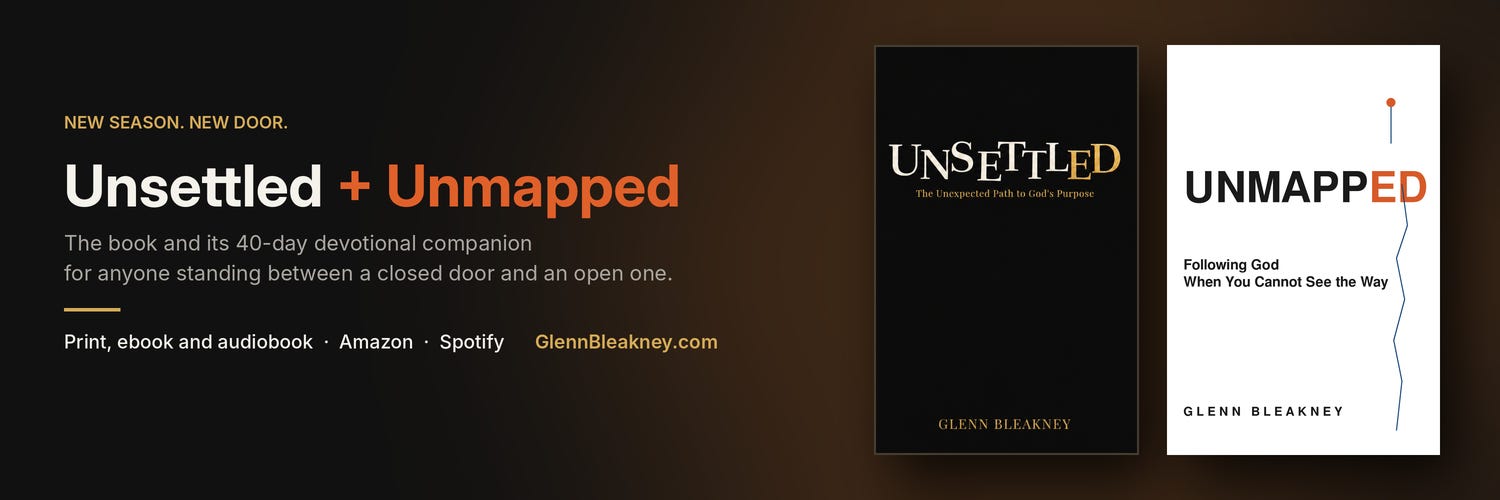
I wrote Unsettled: The Unexpected Path to God’s Purposes for anyone standing between a door that has closed and one that hasn’t opened yet. It shows you how God moves His people through broken plans, lost resources and changing relationships, and what He builds in you along the way. The story of Amalek, the city of Ai and the hallway all come from Chapter 5.
Unmapped: Following God When You Cannot See the Way is the companion book. It’s a 40-day devotional that walks you through this season one day at a time, with Scripture, reflection and prayer.
You can get both books in print and ebook on Amazon in many countries. Both are also on Spotify as audiobooks, and you’ll find them at other stores if you search the titles. You can see everything at GlennBleakney.com.
Unsettled: Amazon US | Amazon Australia | Audiobook on Spotify
Unmapped: Amazon US | Amazon Australia Audiobook on Spotify
Join my destiny mentoring class for free. It’s happening Tuesday, November 17 at 6 PM Central time in the USA and Wednesday, November 18 at 10 AM Australian Eastern Standard Time
Sign up here https://us02web.zoom.us/meeting/register/al_ccyFuQJGyezLvdVLqcQ
Glenn Bleakney
GlennBleakney.com
Discussion about this post