Listen to almost any conference stage, podcast or pastors’ interview today and you will hear the same vocabulary. Great leaders cast vision. Great leaders build teams. Great leaders know when to make the hard call. The phrase is so common that few people stop to ask where it came from, or whether Jesus ever used it.
Recently I watched an interview with a worship leader who has been open about his struggles with faith. He came across as sincere, and I respected his honesty. What troubled me was the conversation around him. He spends time with pastors from the same stream of the church, and again and again the talk came back to great leaders: what great leaders do, how great leaders think, the aspiration to become a great leader. The longer I listened, the more uneasy I became, and I wanted to understand why.
I have searched the Gospels for Jesus training His disciples to become great leaders, and I cannot find it. What I find is the opposite. Every time His followers reached for greatness, He took the word out of their hands and gave them a towel. That difference is more than vocabulary. It shapes how we see ourselves, how we treat the people entrusted to us, and, I believe, how many of us fall.
The Question the Disciples Kept Asking
The desire to be great is older than the leadership industry. The Twelve argued about it on the road to Capernaum (Mark 9:33–34). James and John sent their mother to ask for the seats at His right and left (Matthew 20:20–21). They were still arguing about it at the Last Supper, hours before the cross (Luke 22:24).
Jesus never once answered the question on their terms. He did not give them a ranking, a pathway or a set of habits for rising higher. He redefined greatness so completely that it could only be reached by going down:
“You know that the rulers of the Gentiles lord it over them, and their great ones exercise authority over them. It shall not be so among you. But whoever would be great among you must be your servant, and whoever would be first among you must be your slave, even as the Son of Man came not to be served but to serve, and to give his life as a ransom for many.” (Matthew 20:25–28, ESV)
Notice what Jesus places on the other side of the line. The model He rejects is the ruler of the nations, the one whose greatness is measured by how many people sit under his authority. That is precisely the model much leadership language assumes. When the church speaks of great leaders, it is often asking the disciples’ question again, and Jesus’ answer has not changed: “It shall not be so among you.”
When Jesus Said “Leader”
It would be easy to claim that Jesus never spoke about leaders at all, but that is not quite accurate, and the truth is more striking. At the Last Supper, with the disciples arguing about rank around the table, Jesus said:
“But not so with you. Rather, let the greatest among you become as the youngest, and the leader as one who serves. For who is the greater, one who reclines at table or one who serves? Is it not the one who reclines at table? But I am among you as the one who serves.” (Luke 22:26–27, ESV)
The word the ESV renders “leader” is hēgoumenos. It is at home in contexts of ruling, guiding and going before others, and it appears several times in the New Testament. Matthew uses it of the ruler who would come from Bethlehem (Matthew 2:6). Luke uses it of Judas and Silas, “leading men among the brothers” (Acts 15:22). Hebrews uses it three times for those who lead the church (Hebrews 13:7, 17, 24). The early church plainly had leaders, and the apostles were not shy about naming them.
What stands out is how Jesus Himself handles the word. In the Gospels this is the one time He uses it, and He does so only to bend it into the shape of a servant.
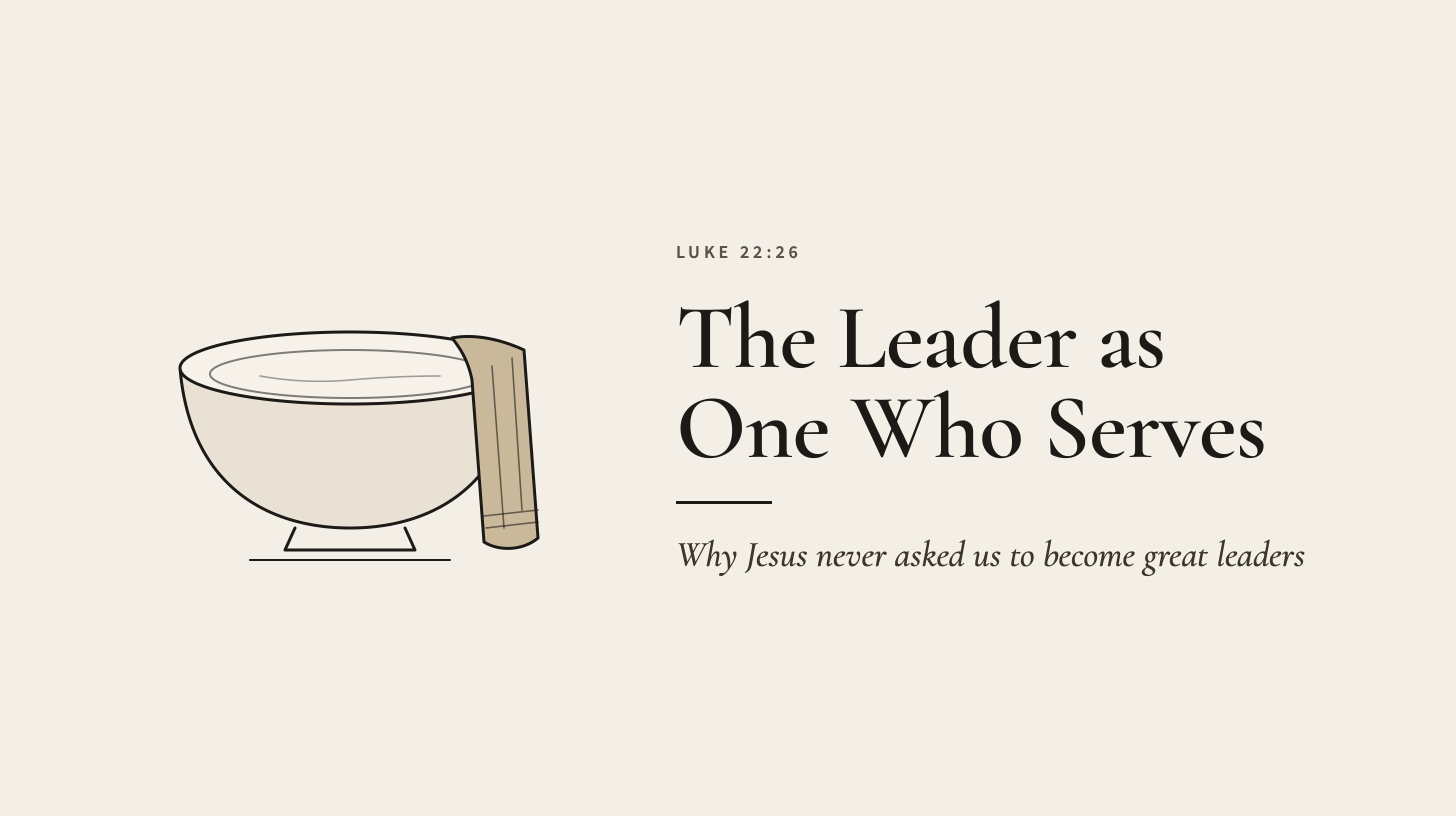
He then points to Himself. The Lord of glory is in the room as the one who waits on the table. In a few minutes He will be on His knees with a basin, washing the feet of men who were arguing about which of them was greatest (John 13:4–5). He did not give them a lecture on leadership. He gave them an example and said, “you also should do just as I have done to you” (John 13:15).
In Matthew 23 He goes further. “Neither be called instructors, for you have one instructor, the Christ” (Matthew 23:10). The word there, kathēgētēs, reaches toward a guide or instructor, someone who leads the way. Jesus reserves that title for Himself and gives the rest of us a different one: “The greatest among you shall be your servant” (Matthew 23:11).
How the Apostles Named Themselves
If anyone in the New Testament had a claim to the title of great leader, it was the apostles. They planted churches across the Roman world, wrote Scripture and confronted kings. Yet when they introduced themselves, they reached for very different words.
Paul, James, Peter and Jude all open their letters as a doulos, a bondservant of Jesus Christ (Romans 1:1; James 1:1; 2 Peter 1:1; Jude 1). Paul tells the Corinthians how they should think of him: “This is how one should regard us, as servants of Christ and stewards of the mysteries of God. Moreover, it is required of stewards that they be found faithful” (1 Corinthians 4:1–2). The measure of a steward is faithfulness to someone else’s household, and the household is never his own.
Paul refused to make himself the message: “For what we proclaim is not ourselves, but Jesus Christ as Lord, with ourselves as your servants for Jesus’ sake” (2 Corinthians 4:5). He called himself the least of the apostles (1 Corinthians 15:9) and the chief of sinners (1 Timothy 1:15). Peter, the rock on whom Jesus said He would build His church, wrote to elders as a “fellow elder” and told them to shepherd the flock “not domineering over those in your charge, but being examples to the flock” (1 Peter 5:1–3). He reminded them that there is a Chief Shepherd, and it is not any of them (1 Peter 5:4).
The one church figure the New Testament names for loving prominence is Diotrephes, “who likes to put himself first” (3 John 9). John does not treat him as a strong leader with rough edges. He treats him as a man who has stopped receiving the apostolic word.
Leadership Is Real, But It Is Not Who We Are
None of this means leadership is unbiblical. Paul lists leading among the gifts of grace and tells the one who leads to do so with zeal (Romans 12:8). Hebrews tells believers to remember their leaders and to obey them, “for they are keeping watch over your souls, as those who will have to give an account” (Hebrews 13:7, 17). Paul calls the desire for oversight the desire for a noble task (1 Timothy 3:1). God has always raised up people to go before others, from Moses to Nehemiah to the elders of Ephesus.
The question is where leadership sits in the order of our identity. Scripture gives us four words that belong together, in this order:
Disciple is who we are. We never graduate from following Jesus. The Great Commission is to make disciples, and the ones who make them remain disciples themselves (Matthew 28:19–20).
Servant is our posture. Whatever authority we carry, we carry it from below, as Jesus did (Philippians 2:5–7).
Steward is our accountability. The people, the gifts and the platform belong to someone else, and we will give an account for them (Hebrews 13:17; 1 Corinthians 4:2).
Leading is a function we exercise for a season and for the sake of others. It is something we do; it is not who we are.
When “leader” becomes the identity, this order flips. Discipleship becomes the stage we passed through on the way to leadership. Service becomes a technique great leaders use. People become the raw material our leadership works on. The words may sound similar, but the centre of gravity has moved from Jesus to ourselves.
When the Leader Becomes the Project
The last two decades have brought a painful run of moral failures among prominent pastors. The causes are many: isolation, unhealed wounds, money, exhaustion, celebrity, the absence of real accountability, and the ordinary sin of the human heart. No single explanation covers every fall. Still, I believe the way we have taught pastors to see themselves is one of the reasons, and it feeds several of the others.
Consider what happens when a man’s calling is framed as becoming a great leader.
The self becomes the project. His growth, his influence, his capacity and his image become the main thing he tends. Jesus’ call was to “deny himself and take up his cross daily and follow me” (Luke 9:23). Self-denial is quietly replaced by self-development, and a heart that is always being built up is rarely being searched.
Accountability flows the wrong way. Leaders are followed; disciples follow. When no one in his life is allowed to treat him as a disciple under correction, he has stepped out from under the very thing designed to protect him.
Results outrank faithfulness. Great leaders are measured by growth, reach and outcomes. Stewards are measured by faithfulness. A results culture will overlook a gifted man’s character for as long as the numbers keep rising, and often that is exactly what happens until the collapse.
The platform needs protecting. An identity built on greatness has to be defended. That breeds image management, and image management is the soil where a hidden life grows.
Gifting is mistaken for maturity. Saul stood head and shoulders above the people (1 Samuel 9:2). He looked exactly like what Israel thought a leader should be. David was a shepherd boy whose father did not think to call him in from the field (1 Samuel 16:11). Scripture’s verdict on the two men was never about competence.
J. Robert Clinton’s long study of leaders in Scripture and history found that most did not finish well. The danger he identified was rarely a lack of skill. It was the slow drift of the inner life while the outward work continued. A culture that keeps telling pastors to become great leaders is training the outward work and neglecting the inner life, and that is precisely where the drift begins.
A Different Vocabulary
The language of the great leader has a history. As the church-growth movement gathered pace in the late 1980s and 1990s, pastors of large churches increasingly looked to the business world for help, and management thinkers such as Peter Drucker became mentors to a generation of megachurch pastors. In 1993 John Maxwell published Developing the Leader Within You, followed in 1998 by The 21 Irrefutable Laws of Leadership, and his conviction that everything rises and falls on leadership became a working creed in many churches. In 1995 Willow Creek convened its first Leadership Summit, framed around the leadership gift of Romans 12:8, and it grew into one of the largest leadership events in the world. By the 2000s, “leader” had become a common word for a pastor, and becoming a great leader a common goal.
Much of this came from a sincere desire to see churches led well, and many who use the language mean something good: faithful servants who lead well. The trouble is that words form us. If we want a generation of pastors shaped like Jesus, we need to speak the way He and the apostles spoke.
Here is what that shift looks like in practice, with what we often say set against what Scripture says:
“Great leaders cast vision.” Disciples do only what they see the Father doing (John 5:19).
“Great leaders build influence.” “He must increase, but I must decrease” (John 3:30).
“Great leaders attract followers.” Disciples make disciples of Jesus, never of themselves (Matthew 28:19; 1 Corinthians 1:12–13).
“Great leaders protect the platform.” Stewards give account for what was never theirs (Hebrews 13:17).
“Great leaders are measured by results.” Servants are measured by faithfulness: “Well done, good and faithful servant” (Matthew 25:21).
“Greatness is the goal.” Greatness is God’s gift to those who go down (Philippians 2:8–9; Matthew 23:12).
This is more than a change of slogans. It changes what we celebrate, whom we promote and what we ask of those who carry responsibility. A church that honours faithfulness above results will notice character long before a crisis forces it to.
The Towel
The answer to the leadership culture is not cynicism toward those caught up in it. “Who are you to pass judgment on the servant of another? It is before his own master that he stands or falls” (Romans 14:4). Many pastors who speak of great leaders love Jesus and serve sacrificially. The call is to examine the framework, and that call applies to every one of us who carries responsibility in the body of Christ, myself included.
So let us stop asking how to become great leaders and start asking the questions Jesus actually asks. Am I still following Him? Whose feet am I washing? Will I be found faithful with what was never mine?
Jesus has already defined greatness, and He did it on His knees with a basin of water and a towel. He told us that whoever humbles himself will be exalted (Matthew 23:12). The exalting is His to do. Our part is to take up the towel.